
We’ve all been there, making a promise to ourselves to lose weight or start a skincare routine, but the next day, we hit snooze because we just don’t feel like there’s any way to start, and motivation just isn’t coming. You have the desire but can’t bring yourself to act, or you tried, but the initial spark began to fade.
We have heard many popular celebrities, influencers, and podcasters say that motivation is the key to success. But, the question is “Is it really a key to success, or what we really need are the actionable habits and mindset shift?”
In this article, we will not only explore why motivation often fails us as per psychological motivational theory, such as the Fogg Behavior Model and Self Determination Theory, which will be explained well. Just know that I will share fun, science-backed tricks to help you understand how to motivate yourself.

The Real Reason Motivation Won’t Save You
Are you just like me, who used to start a day with clichéd motivational quotes and stories, thinking they would set the tone for a productive day? And yeah, it worked—for a while until I realized that we love to believe that motivation is the key to achieving our goals.
However, motivation is not always reliable because it is a psychological state that depends on both internal and external factors.
We often wait for motivation to hit us or rely on podcasts, TED Talks, and motivational speakers to push ourselves toward a certain goal. But this feeling only lasts for a short period of time.
The reason why motivation is so inconsistent is that it is not a stable trait—it can rise and fall based on mood, energy levels, and external circumstances.
A positive emotional state can enhance motivation, while negative emotions can diminish it. Factors like stress, lack of social support, or even exhaustion can make motivation disappear when we need it the most.
Take cooking as an example; whenever I am frustrated, it’s a complete disaster—everything is a wreck. The kitchen becomes a war zone, a battle between my emotions and my attempt to stay composed. But when I am serene, everything turns out great.
This is per the theory of motivation. such as Self Determination Theory (Deci & Ryan). But what is self determination theory? Self-determination theory explains that motivation is influenced by autonomy, competence, and social connections. When these psychological needs are not met, motivation weakens.

Does Motivation Drive Success?
We’ve all heard the stories—how a struggling entrepreneur, actor, or athlete overcame hardships and achieved massive success. Think about Elon Musk, Oprah Winfrey, or Dhirubhai Ambani. They often talk about their lowest points—financial struggles, failures, and rejection—before they turn their lives around.
When we hear these stories, we assume they had a sudden realization, a “This is it! I’m going to change my life!” moment, where motivation struck like lightning, pushing them to success. And so, we wait for that moment in our own lives, believing that motivation is the key to action.
But here’s the problem: Motivation is unreliable.
If motivation alone were enough, everyone would be successful. But in reality, motivation is like a mood—it rises and falls based on energy, emotions, and circumstances.
This is where the Fogg Behavior Model explains what truly drives action. According to the Fogg Behavior Model, we don’t take action just because we feel motivated. Instead, three factors must align:
- Motivation – The desire to act (which fluctuates).
- Ability – How easy or difficult the task is.
- Trigger – A cue or reminder that pushes us to act.
If one of these is missing, taking action becomes difficult.
You can understand this theory of motivation, the Fogg Behavior Model, by thinking about a student preparing for exams. If they only study when they feel motivated, they will struggle. But if they set a fixed study time, keep their books ready, and use reminders (triggers and habits), they stay consistent.
The same applies to success in any field. The key isn’t motivation—it’s systems that make action easier and automatic.

How to Motivate Yourself Only By These 5 Tricks?
Let’s dive into the piece of cake we’ve all been waiting for—how to motivate yourself!
1. Make It Too Easy to Fail:
Ever told yourself you’d start something tomorrow… And then tomorrow became next week? Yeah, same. The trick? Make starting so stupidly easy that failing feels impossible.
Step One: Shrink It Down
If you’re wondering how to motivate yourself, instead of saying, “I’ll work out for an hour,” just say, “I’ll put on my workout clothes.” That’s it. No pressure, no big commitment—just tiny, no-brainer steps. Once you’re in those gym clothes, chances are, you’ll do something.
Step Two: The Two-Minute Rule ⏳
Borrowing from habit guru James Clear: if a task takes less than two minutes, just do it. Small wins trick your brain into feeling accomplished, and that sense of progress? It’s addictive. Before you know it, you’re not just in workout clothes—you’re actually working out, and this is how to motivate yourself.
So, next time you feel stuck, don’t think big. Think tiny. Because the easiest way to get something done… is to make it too easy not to.
2. Turn It into a Game
Let’s be real—boring tasks stay boring unless you make them fun. Enter: gamification—a fancy way of saying, “Turn life into a video game.” This is the best way to motivate yourself.
How to Play the Game:
- Set challenges (Can I finish this task before the song ends?)
- Create rewards (Treat yourself to a snack after finishing a tough task)
- Get an accountability partner (Because losing a bet with a friend is more painful than the task itself)
The Dopamine Hack
Your brain loves rewards. Each small win triggers a dopamine release—the “feel-good” chemical that makes you want to keep going. So, this is how to motivate yourself, that’s dopamine. So, gamify your goals, sprinkle in tiny rewards, and watch motivation skyrocket!

3. Habit Stacking—The Ultimate Shortcut 🔗
New habits are hard. But what if you just added them to something you already do?
How to Stack Habits Like a Pro
- Want to stretch daily? Do it right after brushing your teeth.
- Need to drink more water? Take a sip before checking your phone.
- Trying to read more? Open a book before bed instead of scrolling.
Why This Works: Cue-Routine-Reward Loops
Habits stick when they follow a pattern:
- Cue (Brushing teeth)
- Routine (Stretching)
- Reward (Feeling accomplished)
By linking new habits to existing ones, they become automatic. And when something is automatic, you don’t need motivation—you just do it.
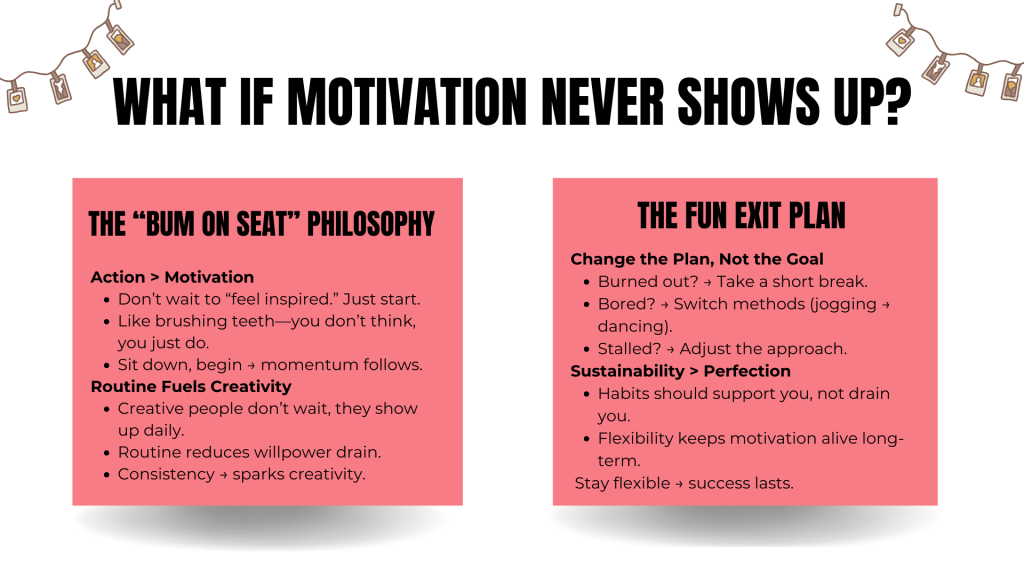
4. The “Bum on Seat” Philosophy 🍑🪑
Waiting for motivation? That’s like waiting for a cat to take commands—not gonna happen. The secret? Stop waiting and just show up.
Action Over Motivation
You don’t wait to feel inspired before brushing your teeth—you just do it. The same goes for work, studying, or creative projects. Sit down. Start. That’s the whole philosophy.
Routine Fuels Creativity
Think the most creative people rely on “feeling inspired”? Nope. They show up daily, and creativity follows. The more you make something a routine, the less you have to rely on willpower.
So, put your bum on the seat, and let the magic happen.
5. The Fun Exit Plan 🚪😎
What if the thing that used to motivate you… Suddenly doesn’t? Simple: Change the plan, not the goal.
When to Quit or Adjust
- Feeling burned out? Take a short break.
- Does habit feel boring? Switch up the method (e.g., swap jogging for dancing).
- Progress stalled? Reevaluate and tweak the approach.
Sustainability > Perfection
Habits should work for you, not against you. The key to long-term success isn’t forcing yourself through burnout—it’s staying flexible and adjusting when needed.
Remember, motivation comes and goes, but a well-built system keeps you going. 😉
Conclusion
If you’ve been waiting for motivation to strike, consider this your sign to stop waiting and start doing. Action fuels progress—not the other way around.
The trick? Make it too easy to fail. How to motivate yourself? Shrink your tasks, turn them into a game, stack them onto habits you already have, and show up whether you feel like it or not.
The more you act, the easier it gets. And when things stop working, don’t quit—just tweak the approach.
So, right now—yes, right now—take the tiniest step toward your goal. Put on those workout clothes, write a single sentence, and drink a glass of water. Once you start, you’ll realize you never needed motivation. You just needed momentum. 🔥
If you like this article, you can also check out:






Leave a reply to How Body Doubling Works and the Top Body Doubling App to Get Started – Mindora Cancel reply