
Do you feel you’re constantly tired, and it may be the kind of tiredness that goes away after a good night’s sleep?
But there’s another kind of tiredness that sleep doesn’t seem to fix.
It’s the kind where your mind feels heavy before the day even begins. Where small tasks feel strangely overwhelming, and things that once excited you now feel distant or meaningless.
You may still be doing everything you’re supposed to do, working, responding to people, being a responsible adult and citizen—but inside, something feels off.
You feel drained.
Detached.
Sometimes, even numb or mentally exhausted after work.
And the confusing part is that you can’t even explain why.
And you might start wondering if something is wrong with you. Some of you even begin to think that maybe I am depressed or just sad.
But in many cases, what you might be experiencing is emotional burnout—a state of deep emotional, mental, and physical exhaustion.
Burnout doesn’t usually appear overnight. It builds slowly, quietly, through months or years of constant pressure, unrestrained labor, and responsibilities that never seem to pause.
By the time you even recognize it, you’re already running on empty.
In a world where productivity is constantly expected, where work follows us everywhere through our phones, and where rest often feels like a luxury, emotional burnout is becoming increasingly common.
Understanding what burnout is and recognizing its early signs and symptoms of burnout can help you protect your mental and emotional energy before it reaches a breaking point.
What Is Emotional Burnout?
Have you ever felt so exhausted emotionally that even doing a small task feels impossible? And you’re constantly wondering what’s wrong with me— This must be emotional burnout—continuously feeling emotionally, mentally, and physically exhausted for a longer period of time.
This can happen because you may be experiencing constant stress at work, caring for someone, or dealing with other emotional challenges, but you don’t get enough time to rest.
Eventually, you run out of energy, making it difficult for you to be motivated, focused, or emotionally engaged. And when you run out of emotional energy faster than you can recharge it, this is what emotional burnout means. Instead of feeling refreshed after some rest, you may still feel overwhelmed, disengaged, or mentally exhausted.
Burnout doesn’t occur suddenly; you may start by feeling a little exhausted and stressed, but you don’t realize it until it becomes a bigger problem—a bottleneck situation.
Emotional Burnout vs Depression
Sometimes you can confuse emotional burnout with depression or the other way around. This is because both conditions share common features, such as Fatigue, low motivation, and emotional exhaustion. They are not the same, though.
| Aspect | Burnout | Depression |
| Emotional tone | You may feel frustrated, irritable, or cynical, especially about the stressful situation causing it. | Feelings are deeper and more persistent, such as sadness, hopelessness, or emotional numbness. |
| Scope | Usually linked to a specific stressor, like work pressure or caregiving responsibilities. | Affects many areas of life, including relationships, hobbies, and daily activities. |
| Duration | Often temporary and may improve once you get rest or reduce the stress. | Typically lasts longer and often requires professional treatment. |
| Response to change | Symptoms often improve when the stress trigger is removed or reduced. | Feelings may continue even when circumstances change. |
Why Emotional Burnout Is Rising Today
If you feel like you’re getting more emotionally drained than you were even a few years ago, you’re right to notice it. Emotional burnout is increasing rapidly worldwide. According to survey statistics, 51% of all workers experienced emotional burnout in 2024. In 2025, 91% of all workers experienced high levels of stress and felt mentally exhausted after work.
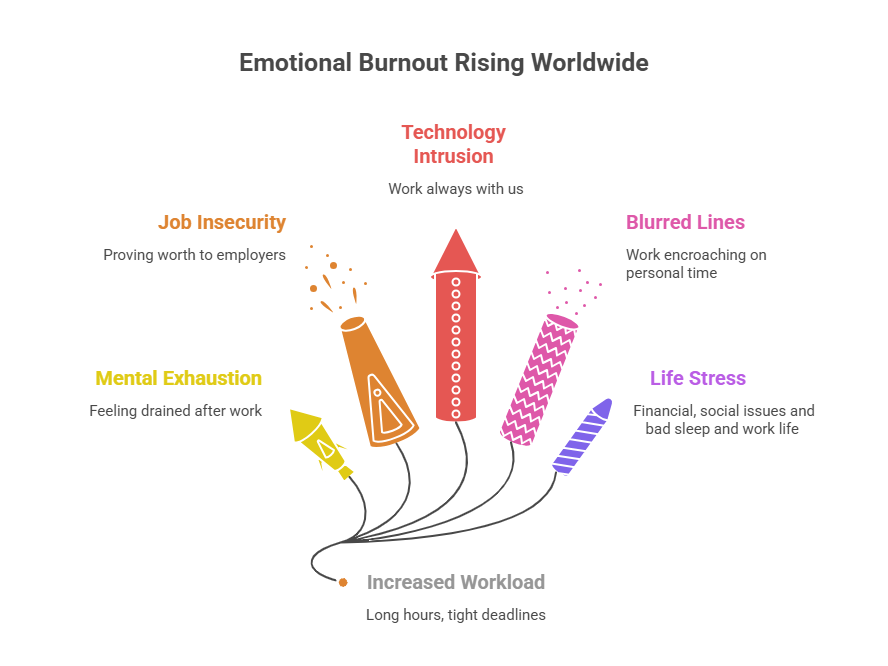
What’s Behind the Increase in Emotional Burnout? It’s a mix of everything.
Workplace Burnout and Pressure Continue to Rise
For many people, the amount of work they do at the office or at the job just keeps increasing. Which is true, sometimes or most of the time, people have to wear multiple caps, not just at work, but after work too.
For one thing, long working hours, tight deadlines, and even unpaid overtime have become the rule rather than the exception in many workplaces. In fact, one of the most common contributors to emotional burnout is a heavy workload, which leads you to feel mentally exhausted after work. If you’re working harder than you used to but getting the same amount of time to recover between each stressful episode, you’re bound to feel burned out eventually.
Another contributor to emotional burnout is job insecurity. In times when the economy seems unpredictable and every moment is a blur, people may need to prove their worth to employers by working harder than ever before. In addition to all that, many industries are facing a shortage of employees to do the jobs that used to be done by many people, not to mention the rise of AI, which has fast-paced everything from adapting and learning to companies laying off many individuals in the blink of an eye.
Technology Ensures That Work Is Always with Us
While technology has made our lives easier, it has also ensured that we carry our work with us everywhere we go. Emails, messages, smartphones, and video calls ensure we are always connected and reachable, even after working hours.
AI tools are pacing up productivity and raising expectations and a sense of responsibility to complete tasks quickly, thereby adding to the workload, leaving us mentally exhausted after work.
Changes in the Post-Pandemic Work Scenario
There has been a significant change in the working scenario since the COVID-19 pandemic. The hybrid model has offered employees flexibility, leading to no clear distinction between personal and professional life. Hence, work has started to encroach on personal time too, causing us to feel mentally exhausted after work due to blurred lines. The situation is worsened by companies insisting on a return to the office, causing stress among employees. If there is no clear role, management, or recognition, employees feel stressed and believe they are not being recognized for their efforts.
Life Outside Work Is Stressful Too
Burnout is not just limited to work life. Life has become more stressful in recent times. There has been financial stress, sleep deprivation, caregiving, and social isolation in many people’s lives. The combination of work and personal stress has increased emotional exhaustion.
The culture of hustle has also contributed to stress, as one feels the need to be productive and constantly work toward their next achievement. This has led to burnout among people over time.
Gender Differences in Burnout
Burnout varies for different people. Women experience more emotional exhaustion than men. This could be because of the “double shift” women have to put in, which includes their job and home life, including caring for children and doing domestic chores.
Women in leadership positions must contend with stereotypes and biases, which can lead to burnout over time.
Men also experience burnout, but in a different way. This could manifest as emotional detachment from their workplace due to workplace burnout. Men do not openly discuss their burnout because of their masculinity.
Workplace burnout in India differs between men and women due to cultural and work-life factors.
Working women in India have to deal with high-stress jobs, and their home life includes their families. Surveys have shown more stress in women than in men in India.
Gender differences in countries like India, where women face gender pay differences, discrimination, and taking time off from work after marriage or giving birth, have caused stress in women. The number of women in the workforce in India has decreased due to more stress for women who still have to go to work.
Why Emotional Burnout Feels Like Depression
Have you ever had one of those days where everything just feels like it’s weighing you down? Even simple things, like replying to a message, completing a project, or making a decision, seem to require tremendous energy.
If you have had one of those days, you might be experiencing emotional burnout. The bad part, though, is that emotional burnout can sometimes mimic depression, and this is why they are often confused with one another.
Burnout and depression have many similar symptoms, and this has caused them to be often confused with one another.
Some of the symptoms you might experience could be:
- Feeling tired all the time, even after sleeping
- Feeling emotionally drained or empty
- Lacking the desire to participate in activities you normally have an interest in
- Feeling frustrated or annoyed by small things
- Having difficulty concentrating or thinking clearly
- Pulling away from activities and social situations
Burnout, as we’ve already explained, results from stress, which eventually drains you emotionally. The stress might make you feel tired and frustrated, but when this stress persists, and you don’t have a break, it can sometimes mimic depression.
The difference between the two, though, will depend on the underlying cause of the emotional sensation you experience. While depression affects all areas of life, even in situations where you don’t experience stress, burnout results from stress in certain areas of life.
How Burnout Gradually Saps Your Emotional Energy
Burnout is a gradual process that develops slowly, step by step.
Your emotional energy is like a battery that is depleted every time you have a responsibility, a deadline to meet, or stress that is always there.
When you sleep, the battery is normally recharged.
When stress is always there, every day, and you are not able to sleep well, the battery is still draining.
At first, the signs and symptoms of burnout are minor, and you might feel:
- More tired than usual
- More irritable than usual
- More are unable to concentrate than usual
Later on, the burden is heavier, and things seem too big to handle. You might find yourself wondering, “Why is everything so difficult?” or “I just don’t seem to have the energy anymore.”
This is because stress is always present, and it keeps your body in a constant state of alert, which can disrupt sleep, mood, and the brain chemicals that are supposed to help you feel motivated and in a good mood.
Later on, it develops into a vicious cycle that goes like this:
- Stress causes a depletion in energy levels
- Everything is too big to handle
- Performance is suffering
- You feel guilty or frustrated
- Stress is now higher than ever
Before you know it, everything is just too big to handle.
What Are the Stages of Burnout
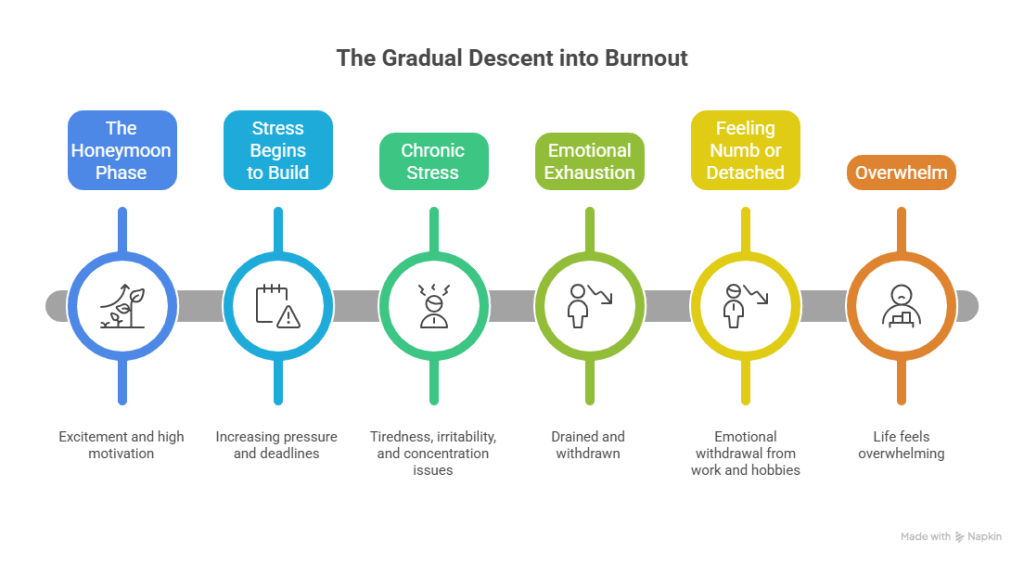
Burnout is a gradual process that goes through different stages of burnout, rather than suddenly appearing out of the blue. This is what stages of burnout actually look like:
- The Honeymoon Phase: You start something new, such as a job, project, or responsibility, and are excited and highly motivated.
- Stress Begins to Build: Deadlines and responsibilities pile up, and you feel increasing pressure.
- Chronic Stress: You feel tired, irritable, and can’t concentrate.
- Emotional Exhaustion: You feel drained and exhausted. Your motivation level is down, and you may start withdrawing.
- Feeling Numb or Detached: Some people may notice emotional withdrawal from work or things they used to enjoy.
- Overwhelm: At this stage of burnout, life can feel overwhelming. Simple things can feel too hard.
When Burnout Reaches a Breaking Point
When burnout has gone on too long, it is not just an emotional state. It can start to impact physical and relational well-being.
Some common complaints of people experiencing are:
- Frequent headaches
- Poor sleep or insomnia
- Constant emotional and workplace fatigue
- Trouble making decisions
- Feeling disconnected from others
At this point, the mind and body are basically saying:
“I’ve been under pressure for too long.”
The good news is that burnout isn’t permanent. Once the source of stress is addressed and proper rest and boundaries are established, people often begin to recover their energy and motivation.
Who Is Most at Risk for Emotional Burnout?
Have you ever asked yourself, “Why do I feel so tired all of the time?” Not just physically, but emotionally as well?
Burnout does not always come with a big, bold, flashing sign of emotional burnout. It can sneak up on you as you go about your life. And, of course, some of us are more prone to burnout just due to who we are.
So, let’s examine a few different scenarios. Do any of these sound even a little bit familiar?
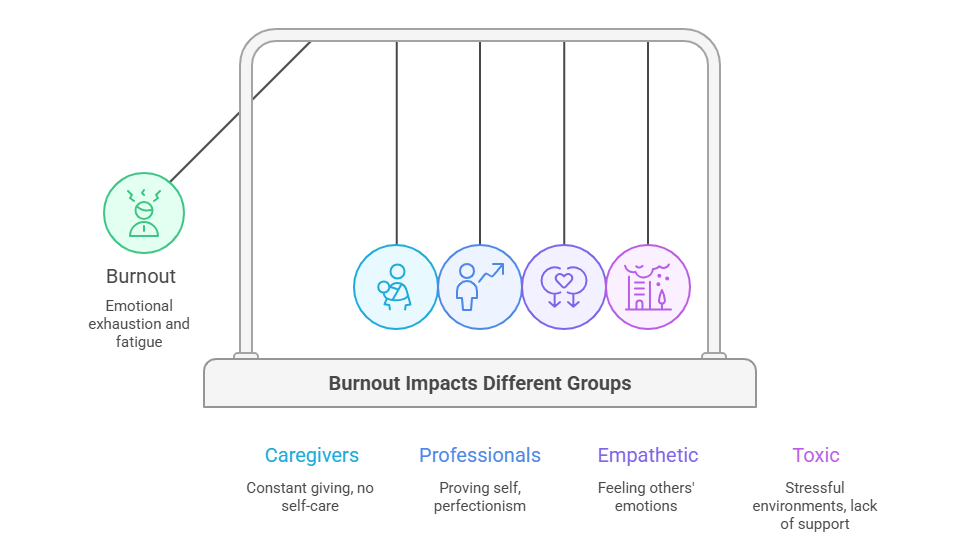
Caregivers and Parents
Are you always giving to someone else? Are you constantly running around, taking care of someone else’s needs? Do you feel like you should always be doing more?
Many parents even feel selfish when they take time for themselves.
It’s no wonder that burnout can happen to parents. In fact, about 8-20% of parents experience parental burnout, especially in households with both parents working and young children who constantly need attention.
High-Achieving Professionals
Do you feel like you are constantly in a position of needing to prove yourself?
High-achieving professionals are often their own worst critics. They work longer hours, strive for perfection, and are constantly worried about making mistakes. These are all situations that can lead to burnout, as one’s sense of self-worth becomes tied to their professional success.
Healthcare professionals are a prime example of this. Doctors and medical residents are known for their long hours and stressful situations. In fact, about 51-80% of these professionals suffer from burnout.
Empathetic and Sensitive People
Are you an empathetic person? Do you feel others’ emotions strongly?
If so, you may be more prone to burnout. Empathetic people are naturally more sensitive to others. They are always ready with a listening ear, a comforting hug, and a willingness to do anything they can to help. But, as a result, their own emotional energy can start to run dry.
People in Toxic Environments
Sometimes burnout isn’t about grinding away at work—sometimes, burnout’s about being in the wrong environment.
If you’re in a toxic work environment or even a relationship, being emotionally stressed means that stress becomes your new best friend. Lack of support, nitpicking, conflict, or being undervalued can wear you down little by little. Before you know it, sleep problems, increasing anxiety, and even emotional burnout can set in.
Research also indicates that a non-supportive work environment can increase your risk of workplace burnout. And, being on night shifts can increase that risk by as much as three times.
So, if you’re reading this and going, “hmm, that’s me…”
Don’t worry, you are not alone. Burnout often shows up for people who care, who put in effort, and who put a lot of themselves into others. Being aware of burnout, however, is the first step to protecting yourself before you burn out.
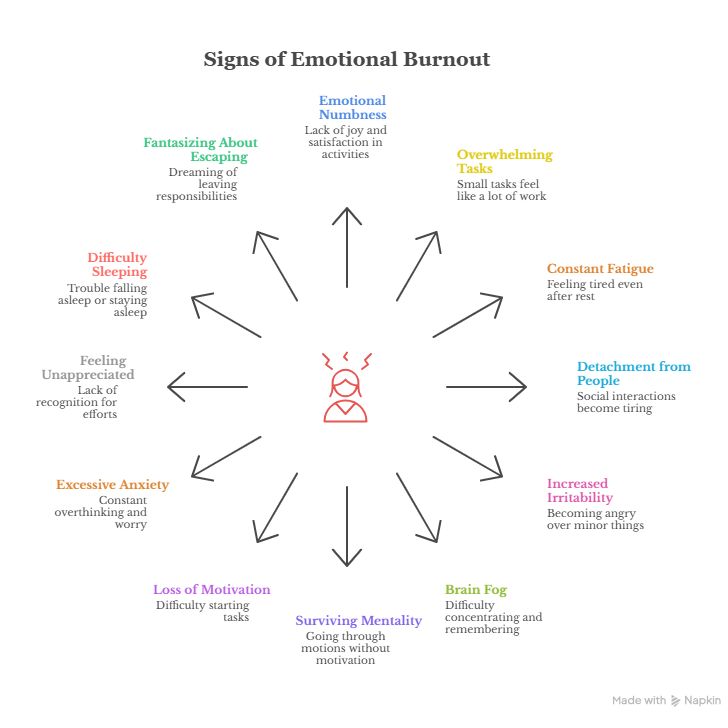
12 Hidden Signs and Symptoms of Burnout Most People Ignore
Emotional burnout does not come out of nowhere. It is the accumulation of a series of psychological changes that most people call “just stress.” However, over time, these psychological changes will reveal a larger problem. The brain and body will be unable to cope with the long-term effects of the stress. Here are the signs and symptoms of burnout you often ignore.
1. You Feel Emotionally Numb
Activities that used to make you happy no longer do. Talking to someone, a hobby, or an achievement no longer provides the same level of satisfaction as it used to. This happens because your brain has responded to the stress. Stress reduces the level of a brain chemical that helps with pleasure. The brain will save energy during long-term stress. This includes shutting down your emotions. This shutdown can be seen in the Maslach Burnout Inventory.
2. Small Tasks Feel Overwhelming
Replying to messages, cleaning the house, or even making a decision can now feel like a lot of work. According to the cognitive load theory, long-term stress can drain the brain. This happens to the prefrontal cortex. This area of the brain controls the decision-making processes. When this area gets tired, small decisions can feel like a lot of work. This can cause you to avoid the decision or procrastinate.
3. You’re Always Tired–Even After Rest
Even after sleeping or taking a break, you still feel tired. This happens because your body has been stressed for a long time. This will raise the level of the hormone that controls stress. This will prevent your body from getting deep sleep.
4. You Feel Detached from People
Your social interactions become tiring rather than comforting.
This phenomenon is referred to as depersonalization by psychologists. It’s a form of burnout in which emotional distance from others increases as a coping mechanism. The brain’s emotional centers, such as the empathy centers and mirror neurons, become overwhelmed. To avoid increasing tiredness, the brain resorts to emotional distancing.
5. Increased Irritability or Anger
One of the many signs of emotional burnout is becoming extremely irritated or angry by minor things.
When you are experiencing burnout, your brain’s limbic system, especially the amygdala, is constantly on high alert due to stress. Your reduced serotonin levels due to burnout make you extremely irritated or angry.
6. Brain Fog and Difficulty Focusing Your Attention
You start to forget things or become unable to concentrate or complete tasks.
This phenomenon occurs due to burnout’s effects on working memory. Long-term stress overwhelms the working memory. As a result, the prefrontal cortex becomes less effective. The prefrontal cortex of the brain is the part that helps you concentrate your attention.
7. You Feel Like You’re Just “Surviving.”
You feel like you’re not doing things with any sense of motivation or inspiration. Your life feels like you’re just going through the motions from one responsibility to another.
This phenomenon results from burnout’s effects on your self-efficacy. Burnout affects your self-efficacy or your ability to find meaning in life.
8. Loss of Motivation
It is difficult to start even the easiest of tasks.
This is caused by chronic stress’s effects on the brain’s reward system, especially the nucleus accumbens, which uses dopamine to generate motivation.
9. Excessive Anxiety or Overthinking
You find yourself constantly thinking about the same things, conversations, or scenarios.
This is caused by the overactivation of the brain’s default mode network, which is responsible for internal thoughts, especially during chronic stress.
10. Feeling Unappreciated or Invisible
You feel like the emotional energy you invest in relationships, work, or parenting is not being acknowledged.
Equity theory posits that people seek balance between the level of investment and the level of return in relationships. When this balance is not acknowledged, resentment may occur, especially the feeling of being invisible.
11. Difficulty Sleeping
You may find it difficult to fall asleep, even when you feel extremely tired. Some people may sleep more but still feel extremely tired.
Stress hormones, especially cortisol, interfere with the production of the sleep hormone (melatonin), thereby disrupting the body’s natural sleep schedule. They prevent the body from getting the restful sleep it needs.
12. You Fantasize About Escaping Everything
You may fantasize about leaving work, going away for a while, or escaping all responsibilities.
This is caused by the brain’s escape response, which tries to relieve overwhelming mental and emotional stress.
A Simple Exercise That Might Help Break Burnout
Of course, if a number of these burnout signs and symptoms sound like you, you may be wondering what you can do to break this cycle. One technique that psychologists have found to help people overcome stress and emotional fatigue is Cognitive Behavioral Journaling (CBT-J).
But what is CBT Journaling? It’s basically a self-guided, reflective practice that helps you apply the core principles of Cognitive Behavioral Therapy, a therapeutic approach that helps you identify negative behavior and thinking.
Writing daily to identify what you think, the challenges you face, and help you reframe unhelpful and negative thought patterns that cause emotional distress.
When we experience burnout, it’s because our brain is stuck in a pattern of automatic negative thoughts (ANTs), a series of quick, negative judgments about situations in life. “ANTs are automatic, negative, and uncontrollable thoughts,” write psychologists Albert Ellis and Raymond DiGiuseppe in their classic textbook on CBT. “They are a series of quick, judgmental, and usually negative evaluations of people, objects, situations in life, and so on.” For example, these thoughts might include:
- Catastrophizing: “Everything I do is a failure.”
- All-or-nothing thinking: “If I’m not perfect, I’m worthless.”
This series of thoughts and emotions creates a stress cycle in our brain, leaving us constantly stressed. CBT journaling breaks this cycle by allowing us to write down these thoughts and determine if they are actually true.
Download the CBT Journaling Worksheet for free below.
Conclusion
Emotional burnout is far more common than most people realize. In a world that constantly demands productivity, responsiveness, and emotional availability, people often push forward without even noticing how drained they’ve become.
If many of these signs of emotional burnout felt familiar, it doesn’t mean something is wrong with you. It simply means your mind and body may have been carrying more pressure and burden than they were meant to handle for too long.
Burnout often affects people who care deeply, work hard, and give a lot of themselves to others. But you’re not alone in this.
The important thing you should remember is that emotional exhaustion is not a permanent state. When you address stress and its source and acknowledge your emotional needs, you can gradually regain your energy, clarity, and motivation.
Sometimes the first step toward recovery is simply recognizing what you’re experiencing and permitting yourself to slow down.
In the next guide, we’ll explore practical ways to recover from emotional burnout and rebuild your emotional energy step by step.

Leave a comment